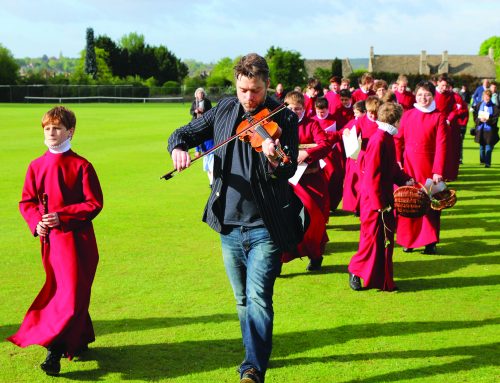
Paul ’Silk’ Silcock, landlord of The Gardener’s Arms in Plantation Road, leading by example.
The Old Bookbinders is a ‘friendly, nook-and-cranny-filled’, ‘slightly shabby lovable’, ‘good solid Jericho pub’, ‘full of locals, posh students and OUP workers’. (That, at least, is what the reviews in Daily Info used to say.) Its name and its location tell of the happy conjunction of two of Oxford’s favourite commodities – books and beer.
Books we all know about. Beer is a less trumpeted aspect of our heritage – which is a great oversight, because Oxford has a richly hoppy history.

Jericho might not boast a brewery; but it does have a claim to be the spiritual home of modern beer-drinking, for it currently houses no fewer than six hostelries, each pleasingly distinct from the other yet at the same time close enough to make pub-crawling a literal possibility.
Here they are – the glorious sextet:
- The Harcourt Arms – named after the noble family who owned much of the land nearby. It’s the locals’ Local, with a big-hearted landlord, two glowing fires, and an exuberant open-mic session most week-ends.
- The Rickety Press – a tasteful if somewhat contrived revamp of the late lamented Radcliffe Arms, younger sibling to The Rusty Bicycle off the Iffley Road and The Up In Arms, New Marston.
- Jude the Obscure – named after the protagonist of Thomas Hardy’s novel, who worked as a stone-mason on the buildings of ‘Christminster’. What he’d have made of its three giant Sports TV screens is uncertain.
- The Jericho Tavern – on the site of a seventeenth-century mansion: Jericho House. A place where more than a few decent bands have played: Radiohead, Supergrass, Ride, Foals, Mumford & Sons …
- The Victoria – which erroneously claims to be in Jericho (it’s on the wrong side of Walton Street) but boasts a summery poop deck, and more rooms, staircases and stuffed animals than all the other pubs put together.
- The Old Bookbinders (aforementioned) – which, as well as alcohol, serves a selection of delicious savoury crêpes and offers a free scoop of monkey nuts from a beer barrel by the door.


Once upon a time Jericho afforded many times this number of drinking opportunities. The notorious Drink Map of Oxford (1883) features 27 premises where one could slake one’s thirst (out of a city total of 319; and those were the days when Oxford’s population was a quarter of its present size.)

Gone in living memory are: The Carpenters Arms – rumoured to be haunted by a medieval monk; The Globe – home to a famously cantankerous landlord; and The Bakers Arms – which later became a Buddhist centre.
Gone too are pubs across the whole swathe of Oxford – vanished like the blurred memory of an epic night on the tiles, with only the occasional wince and flashback to remind us: here a bricked-up doorway and strangely large window, there a ghost-sign and lingering wall-plaque …
Who now recalls those names which once tripped so bibulously off the tongue? The Coach & Horses, Cock & Camel, Crown & Thistle, Horse & Jockey … They’ve all gone, along with The Cricketers Arms on Iffley Road, The Old School House in Gloucester Green, The Jack Russell in Marston, The General Eliott in South Hinksey, The Seven Stars in Grandpont. And many more. The Bullnose Morris, home to a thousand well-oiled car workers, served its last pint in 2020. Even The Brewery Gate, once portal to Oxford’s biggest beer-maker, Morrells, has been forced to call ‘Time’.

So has the most infamous watering-hole of them all, The Wharf House, which closed in 2006. Home to lost legions of Oxford’s legless, this ‘dry dock’ on a ‘concrete island’ (between Speedwell Street and the A420) with its ‘rotten cargo’ of ‘beetroot face’(d) desperados, and its ‘snarling black rat’ of a pub dog* was the scene of some legendary antics, the most notorious being the late-night ejection of its landlord, Tony Flatman – via the front window.
[Not quite as violent, of course, as the three-day town/gown riot which kicked off at The Swindlestock Tavern, Carfax, and resulted in the death of nearly a hundred people, one of them scalped. But that was a few centuries ago – in 1355 to be precise. The tavern itself closed in 1709.]
It’s been Last Orders all round for so many celebrated drinking establishments, especially in recent years as our city has gentrified and public houses have become ever more private. But we mustn’t complain. Oxford still has more bars per capita than just about any other town in Britain, and we are happy in the knowledge that so many of them retain a distinctive character and quality. The Lamb & Flag has recently re-opened as a community pub on St Giles and there are signs that its famous Inkling sibling, The Eagle and Child across the road, may soon follow suit.

At least two dozen pubs sell real ale, as highlighted by CAMRA in their 2025 Good Beer Guide. The Rose & Crown, under the legendary management of Andrew, Debbie, and Adam Hall, has starred in that list no fewer than 33 times, and The Mason’s Arms in Headington Quarry this year celebrates its twentieth consecutive accolade. Among new entries is The Jolly Farmers in St Ebbe’s, where, as it proudly proclaims, ‘not even the walls are straight’.

Beer is not the only beverage on tap, of course. Far from it. Oxford now boasts a range of cocktail clubs, a few thriving wine bars, and various licensed restaurants. Until recently we even had a gin distillery and whisky brand, originated by our very own ‘Mr Toad’, Tom Nicolson.
Meanwhile, the centre of town is positively awash with revellers at the weekend – George Street in particular. The roof-terrace of the Westgate affords some intoxicating views. And the Covered Market, once an alcohol-free zone, has recently jumped off the wagon in triumphant style with the introduction of The Market Tap, Gulp Fiction, and Luciana’s marvellous Teardrop microbar.
You’re never more than a few yards away from a merry Oxford pub of some kind – and it’s remarkable how easy it is to embark on a tasting-tour by foot. As Inspector Morse put it: ‘There’s always room for one more pint.’ These are very good times in which to raise a Yuletide cup.
Cheers!

* lyrics from a surprisingly melodic song, The Gentlemen’s Bar, written by Wharf survivor, Pete Madams – a link to which features in this vivid Reminiscence by Rob Walters:

Feedback
Simon Howard writes:
One fine establishment can be seen decomposing before our very eyes. It’s not strictly speaking in Oxford, being half a mile beyond the Ring Road, but everyone who lives here will surely have visited it at some stage over the years: The White Hart at Wytham. A charming building in an idyllic setting, with its roaring fire, flagstone floor, sunny courtyard, dovecot, and an area out the front where on summer evenings people could play Aunt Sally. For me as for so many others, it holds nothing but happy memories. What is to become of it now?

Bryan Pickup tells the interesting history of The Old Horse & Jockey:
The former Horse & Jockey Inn at no.69 was probably the earliest building on that stretch of Woodstock Road, and gave its name to Horse and Jockey Lane (now St Bernard’s Road) which led to Walton Well and therefore to Port Meadow. The inn was for many years the headquarters of the Stewards of Oxford Races, which were held on Port Meadow. It contained a bowling alley, and there was stabling (for at least half a dozen horses) behind. The 1878 Ordnance Survey map and a May 1877 photo of the old building show a ‘layby’ in front so that coaches could halt, with a row of trees to separate that space from the road. The racing on Port Meadow ceased after 1878 following a row between the race organisers and the commoners of Wolvercote. The old inn was demolished and rebuilt in Victorian brick as a pub in 1880. It closed in 2002 and its buildings were converted to apartments, with some new buildings replacing the stables. The rather useful public toilet here was closed by the Council but is still visible. A previous pub manager recalls that it was occasionally frequented by Bill Clinton (who lived in nearby Leckford Road) in his student days.


There are several people in Oxford who are extremely knowledgeable about brewing, brewing history, pubs, and real ale. Chief among them is Dave Richardson of CAMRA, editor of The Oxford Drinker, and author of the best book on the subject: Oxford Pubs.
He estimates that a total of 100 real ales are currently being served in Oxford, down from 125 in 2019, with 72 different ones (down from 90) from 41 breweries (down from 46)
The least expensive pint is purchasable at Wetherspoon pubs such as The Four Candles. The most expensive (over £7!) is to be found at The Turf Tavern.
Dave has also written a fascinating and very amusing piece about pub name changes, prompted by the furore that greeted the decision to rename The White House on Abingdon Road The Slow & Steady, and to revert The Angel & Greyhound on The Plain to its former name The Oranges & Lemons.

Talking of names, we were impressed by the range of libations available at the Oxford Beer Festival held in the Town Hall last year, and more than a little curious about the intriguing brands on display, one of which was a heady brew entitled ‘Egg-Shaped Balls’.

The Museum of Oxford pays proper attention to the importance of brewing in our city’s history, and features an interactive quiz for those in need of a visual prompt.


Stuart McAllister serves excellent beer and wine at The Teardrop and The Market Cellar Door. We invited him to share some youthful memories:
The Carpenters Arms in Nelson Street, Jericho, had no regard for licensing hours. It was open any time if you knew the ‘right knock’ on the door. After various police raids it was eventually sold and converted into two dwellings, of which only one was entitled to a parking permit.
The Globe, close by, was the perfect spot to watch Gaelic Football, Hurling, Horse Racing, and Celtic football matches. The landlord used to take his tea (supper) at a table wearing his slippers.
The Radcliffe Arms aka ‘The Raddy’ was a 1970’s music venue and the only pub known to us that was open on Christmas Day evening. As youngsters we travelled far and wide to escape the traumas of a family Christmas!
Opposite The Vic, on the roundabout at the junction of Walton Well Road, Walton Street and Kingston Road, were The Walton Ale Stores which seemed to attract a very mixed clientele. I was never quite brave enough to venture inside as a lad… rogue goings-on were rumoured to occur within.
Not a pub per se, The Caribbean Club behind what was then Oxpens College was our stomping ground of choice late on a Friday. It looked like a village hall, with elderly Caribbean gentlemen dispensing cans of Red Stripe from a trestle table. One week the music was the deepest dub and reggae, the next the latest pogoing, spitting local 70’s punk band. Happy Dayz!!
Several of Oxford’s most famous pubs are conspicuous by their absence from the above Story, including the three oldest. The venerable trio do, however, feature in a previous Morris Oxford post entitled Bear Inn Ties:


The Revd Richard Smail writes:
Mention of The Wharf House brought to mind my favourite overheard remark there:
One customer to another: ‘You’re nowt but a good-for-nothing dosser!’
Reply (not quite straightening his tie): ‘I’m not a dosser, I’m a tramp.’
Although I wasn’t present when the saintly and long-suffering Tony Flatman was thrown out of the window, I was there when someone was thrown IN through the window!
The closures are so sad…
Liz Woolley writes:
Oxford has a long and rich history of brewing, as well as of pubs. Kelly’s directories from the mid-Victorian period show that there were at least eight major commercial breweries, plus a number of smaller ones (and that didn’t include the college brewhouses). Over time all the city’s breweries – apart from Morrell’s – were take over by Hall’s. Anyone wanting to know more should lay hands on a copy of Mike Brown’s excellent book Oxon Brews: The Story of Commercial Brewing in Oxfordshire, published in 2004 by the Brewery History Society.
Talking of Morrell’s, Philip Hunt has an interesting recollection:
I have fond memories of Morrell’s bitter, especially after discovering at a works tour of the brewery how it was supposed to be served (very flat, with almost no head but a delicious flavour, probably down to the water sourced from the stream by Paradise Street). Morrell’s had two cats on the payroll as I recall, to keep the rats under control.