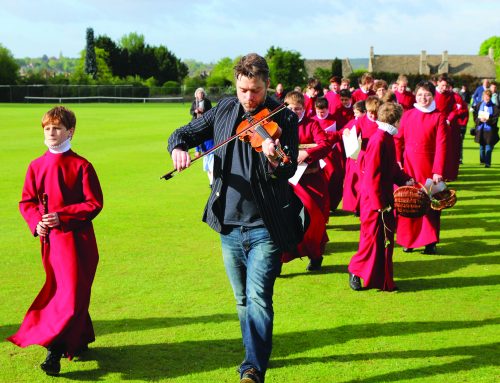
We were privileged recently to be present at an event very few people in Oxford have ever witnessed: the opening of the Non-Licet Gate.
The what?


Stranger than cheese-rolling or bungee-jumping, rarer than a solar eclipse or change of Prime Minister (it occurs but once every three years) it is an arcane ceremony, pompous and costumed. Typically Oxford you might think: and you’d be right – but perhaps not for the right reasons. For what it represents is something deadly serious. Nothing less than the safety and survival of the citizens of Oxford.
This is what happens, and here’s how it all came about:

At approximately 10 o’clock on a weekday in October (Wednesday 23rd this year) the Lord Mayor and officers of the City Council assemble at the Town Hall to don their robes. They depart at precisely 10.45 and, led by the City Mace, process in full regalia along The High.

From there they promenade up Queen’s Lane, past St Peter-in-the-East, until, at the corner of the facing wall, they reach a gate.


The Lord Mayor’s Sergeant knocks three times on the gate and requests permission to enter. Assembled on the other side of the wall are the Warden and Fellows of New College. They duly consider the request. If granted, the gate is opened. The Councillors step inside the college grounds, and the Lord Mayor proceeds to examine the walls. Whereupon, having been satisfied as to their state of repair, the assembled dignitaries make their way to a reception. Refreshments are served. Brief toasts are exchanged, and, on occasion, the college choir is invited to sing.
How did such a ceremony come about?
Some say that the streets and defences of Oxford were laid out by King Alfred the Great. It was more likely to have been his son, Edward the Elder (d.924); but no matter. The point is that Saxon Oxford was an important burgh or defensive settlement, and the key components in that defence were its encircling ramparts and walls. These were further fortified and massified a century or so later, following the Norman Conquest and the consolidation of Oxford Castle.

Maintenance of the walls was all-important – literally a matter of life and death. So when, in 1379, King Richard II granted William Wykeham the right to purchase a substantial parcel of land on which to build his college, part of the condition of sale was that the battlements must not be compromised and the college would maintain them in perpetuity.
said walls to be kept in a competent manner of reparation, and also that the commonality of the said town might have free passage in times of war through the said posterns for the defence of the said town.
To that end the walls were to be inspected by the town authorities every three years.

And why the name Non Licet?
Because passage into New College was not automatic. This was private property, established and administered by the governing body of the college, not subject to the civil authorities. Explicit permission to cross the threshold had to be given by its Warden and Fellows. Entry on any other terms would have been illicit.
You can book a fascinating tour around the line of the original city defences c/o the Oxford Preservation Trust. Chances are you’ll be guided by one of its senior members, the distinguished archaeologist and historian, Julian Munby, who knows more on this topic than anyone, and has first-hand experience of excavating various sections of the wall.
If you can’t visit the walls in person, then Stephanie Jenkins’ virtual tour is thoroughly comprehensive, and features some fascinating old prints together with modern photos.

The walls originally enclosed an area of approximately 115 acres and were bolstered at intervals by at least 21 semi-circular stone bastions of which a dozen remain. Most of them are obvious, massive and in plain sight; but there are a few hidden surprises, like the one in the back garden of the former Oxford High School for Boys.


The total circumference was approximately two miles. It was pierced by four main gates at the cardinal points of the compass. Tolls were collected at these entrances, each of which had its guardian church, dedicated to St Michael (North and South), and St Peter (East and West). And there were four other smaller gates – Smith, Turl (supposedly derived from ‘Twirl’), Little Gate, and one other near St Frideswide’s which is unnamed in the records. At the peak of its protective power much of the wall would have been surrounded by a ditch and a moat.

The irony of course is that New College’s are now the best maintained sections of the wall whereas those for which the Town Council had responsibility have been neglected and in many cases bulldozed to make way for traffic. The area around the West Gate is particularly bereft.
The most dramatic view of the wall as a defensive structure is to be gained from the perspective of the Turf Tavern, preferably glass in hand, staring up at the crenellations and the giant fourteenth-century bell tower which looms, 131 spiral steps, overhead.

If you wish to get the best sense of the walls as they must once have been in the time of William Wykeham, you need to go into New College itself. (The original entrance is via the portal in New College Lane, directly under the watchful eye of the Warden’s Lodgings.) There you will behold the walls in all their glory and be able to inspect them close up, just as the dignitaries of Oxford do, once every three years.


But you won’t, we fear, be able to leave by the Non-Licet Gate.
This Story was inspired by Professor James Willoughby, palaeographic polymath, and developed in conversation with David Hawkins, the Lord Mayor’s Sargeant. Warmest thanks to both, and to the Warden and Fellows of New College.
Video: M.M.Morris
Oxford Preservation Trust, in conjunction with Oxford Archaeology, have produced this self-guided tour.

Feedback
STOP PRESS:
There has recently been a dramatic and significant discovery about the course of the original town walls, which has been revealed to run North/South beneath what is now Oriel College. This report is from the BBC:
https://www.bbc.co.uk/news/articles/cg4q0l3e5x6o
It concludes:
When T.E. Lawrence observed the excavation of the Bodleian underground bookstore at the northern end of Radcliffe Square in 1909 he did not record a large defensive burh ditch running through the site southwards. For this and other reasons there has long been uncertainty about the presence and location of a smaller, primary burh at Oxford. It is therefore lovely to get such a clear result from the Oriel site, with the ditch located slightly to the east of the previously anticipated line.

David Radford, Oxford’s Chief Archaeologist, comments:
It was indeed an exciting discovery. Below is the forthcoming Oxford City and County Archaeological Forum (OCCAF) report note:
Between July and September an archaeological investigation was undertaken by Oxford Archaeology at the site of the former Oriel College Kitchen on Magpie Lane. Previously in May two east-west close-spaced archaeological borehole transects were completed at the site. The results appear to have confirmed the route of a north-south primary burh ditch first suggested 125 years ago following excavations in the Clarendon Quadrangle, where a wall and bank were recorded heading south-east. The presence of a smaller or ‘primary’ defended town or burh, protected by a bank and ditch, that may have been later expanded eastwards and westwards, has long been a topic of discussion and debate. For example, in 1956 the eminent local archaeologist E.M. Jope wrote that:
“The suggestion that the part of the town to the east of the re-entrant angle at Smithgate, north-east of the Bodleian, was an eastward addition to an earlier enclosed town cannot be supported by positive evidence and…there are other indications that this would not represent the true development of the town.” (E.M. Jope 1956)
The boreholes appear to show the ditch, some 20m wide and 3m deep, approaching from the north-east, a line consistent with the old parish boundary that runs through the college. The initial radiocarbon dating results suggest that the organic fill at the base of the ditch dates to the late 9th-10th century, consistent with the construction of a primary burh by King Alfred or his children, although the range is still relatively broad and an earlier date for the construction of the ditch remains possible as we should factor in the possibility that it was kept clear/scoured out for a period before being allowed to silt up. A further round of borehole work was undertaken after an attempt to excavate a deeper sondage was abandoned due to logistical issues and therefore further results are anticipated.


Further excavation work is due to be undertaken at this site. A separate historic building record is also being undertaken by Oxford Archaeology.
The Inspectors call …


These are the fine gentlemen who looked after us on the day and ensured that neither humans nor walls succumbed to injury. They are, from left to right, Karl, Paul (Head Groundsman) David, Jason (Maintenance Manager). In overall charge of the magnificent college gardens for nearly fifty years is the Gardening Fellow and distinguished historian of Classical Antiquity, Robin Lane Fox.

Duncan Taylor writes:
Mention of bastions and ‘hidden surprises’ brings to mind this little-known survivor, squashed behind the latest Jesus College accommodation building in Ship Street.

The bastions were genuinely defensive not simply for show – witness the angling of the window slits:

Dorothy Edmunds writes:
Have you noticed this plaque on the side of the Eastgate Hotel? It’s a reminder of what the old East Gate might once have looked like before it was demolished in the eighteenth century.

We were honoured to hear from our former Lord Mayor, and current Sheriff, James Fry (who also happens to be an alumnus of New College.) He writes:
The section of wall that you inspect from the upper level (at the eastern end, with an entrance leading to the graduate Sacher Building and near the original Morris Motors’ premises), is, or was during past inspections, protected by scaffolding because the state of the entire wall is no longer suitable for long walks. I gather New College students are now threatened with immediate expulsion if they climb up and walk along the wall.
Another point, which may not be known by Morris Oxford readers, is that all along the basements of the northern houses on Ship Street you will find remnants of the old wall. The section under the now closed Turl Street Kitchen is superb.
Pat Quinlan writes:
Since reading the piece I’ve started noticing some fragments of wall dotted around the town, none more fragentary than this:

It would appear that there have been twentieth-century attempts to breach the city walls. Adrian Bullock recently spotted a reference to his father (who went on to become University Vice Chancellor) in the New College Record, in a recollection from Stuart G Hall (1949):
We retired to the Hall for what was by the then meagre standards of post-war scarcity a sumptuous feast. Towards the end of the meal, the Dean, Alan Bullock, addressed us. He was a distinguished historian, and at other times presided over a history and dining club calling itself ‘Bullock’s First Regiment of Foot’. He announced to the diners that miscreants were attempting to break into the college, and he invited volunteers to help him deal with them. In fact, a considerable gang of Trinity men were in New College Lane hammering at the gate of the Old Lodge. They had also hurled missiles at the Warden’s rooms above the Lodge, and broken a window. Warden Smith had remonstrated with them from the window, doubtless in the measured Aristotelian terms that he normally used. Dean Bullock announced that volunteers should assemble in the college garden where they would all be for one night enrolled in Bullock’s First Regiment of Foot, and would deal with those trying to break in. Twenty or so volunteers followed the Dean out of the Non Licet Gate by St Peter’s-in-the-East and up New College Lane, where they took their enemy in flank and rear. I saw the Dean himself, a sturdy man, taking two Trinity men by their collars and hurling them in the direction of Hertford College. As soon as the immediate vicinity of the gate was clear, two New College men emerged through the door of the gate with a fire hose, and washed the hooligans away as far as the Bridge of Sighs (which I believe had itself suffered damage that night). We retired into the college, pleased with ourselves, and I went to bed.
Ronald Shelton writes:
Apart from New College, the other section where the wall may be seen at its most extensive is overlooking Christ Church Meadow – the back walls of Merton College and Corpus Christi marking the edge of the path known as Deadman’s Walk. One or two of the bastions there are particularly well defined.
We need to remember that the wall would have appeared more imposing in former days. It has been lowered over the centuries by the colleges to improve the view out across the meadow towards the river; and the ground level has increased significantly.