John Copcot of The Queen’s College, Oxford, was wandering through Shotover Woods one fifteenth-century day when he heard a strange rustling in the undergrowth. He swung round and was horrified to behold a wild boar hurtling towards him. Armed only with a leatherbound volume of Aristotle (or was it Thucydides? legends vary) the quick-thinking student thrust it into the gaping jaws of his tusked assailant with a cry of Graecum Est!* – whereupon the slobbering beast fell down dead.


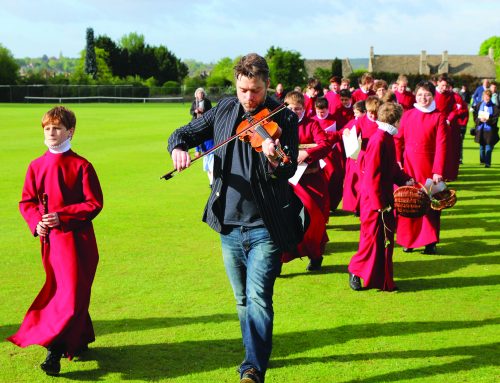
In due course Copcot returned to his college, boar carcass triumphantly in tow. The animal was slowly cooked and quickly devoured by his appreciative fellow students. Thus was a tradition born. To this day, over 500 years later, a Christmas feast is held each year at Queen’s during which a boar’s head on a silver platter is paraded into the dining hall as the centrepiece of the college’s Yuletide celebrations. Instead of an edifying tome, however, it has a decorous orange in its mouth.
There aren’t many wild animals in Oxford any more – though there are still a few dead bores. Closed is the Big Game Museum which once stood on the Woodstock Road. Gone too is the zoo in Kidlington where, for a brief period (1931-36) awestruck visitors could gaze upon an elephant, a lion, a giraffe, camels, kangaroos, jackals, llamas, a family of five baboons, a grizzly bear, a stork, and a guinea pig – all for an entrance fee of sixpence.

The problem was that the zoo also housed three wolves who, one night, managed to break out through a gap in the perimeter fence. Two were quickly recaptured, but a lone lupus remained at large for three days, striking terror into the neighbourhood. Eventually it was tracked down and terminated by an intrepid Oxford Mail photographer armed with a rifle as well as a camera. ‘My best shot,’ as he memorably put it.
Our city’s association with animals is deep and ancient. After all, it takes its very name from a beast. Its coat of arms features an elephant, a lion and a beaver as well as the eponymous ox.

And every college in the University seems to have its own distinctive animal association:

All Souls and mallards
Brasenose and crocodiles
Corpus Christi and tortoises
Hertford and harts
Magdalen and deer
St John’s and peacocks
Worcester and swans

That’s even before you consider animals in other contexts: in pre-history (dinosaurs and ammonites) in mythology (dragons and unicorns) in heraldry (martlets and gryphons) in literature (cheshire cats and white rabbits) in art (Uccello’s The Hunt in the Forest is perhaps the most famous painting in the Ashmolean) in statuary, and in sculpture (including our favourite: the Revd Graham Midgley, Chaplain of St Edmund Hall in the late 1960s, and his beloved labrador Fred, both wearing dog collars.)

A stunning new stained glass window has recently been installed in Christ Church Cathedral (the first for over a century). It depicts St Francis of Assisi surrounded by all creatures great and small. And if you venture into Worcester College Chapel you will be rewarded by a veritable menagerie, for each pew houses a different, beautifully carved, exotic animal: from emu to walrus, from camel to whale.
As if all this isn’t enough, Oxford also boasts the UK’s most famous flying Shark …

… and the world’s most celebrated ex-animal. Better known even than Monty Python’s Norwegian Blue parrot. So famous in fact that it gives its name to an unforgettable alliterative simile:
‘Dead as a Dodo’
Recognised for ever by its memorable name, immortalized in world literature by Lewis Carroll, accorded its own display cabinet, and stared at in wonderment by hordes of visitors to Oxford’s Natural History Museum, the Dodo’s greatest distinction … is its extinction.
*Graecum Est! – The literal translation is: ‘It’s Greek’.
The colloquial rendition might be something like –‘Take that, if you like a bit of Greek!’

Feedback
The incomparable Stephanie Jenkins noticed these two stunning animal profiles on lead downpipes.


She also spotted a grinning Cheshire Cat in the Botanic Garden …

… and took this sequence of photographs of all the oxen from last year’s Ox-Trail:

Once you start noticing Oxen around the place it can become addictive:


Designer Mike Brain kindly sent this page from a booklet he produced featuring the former Big Game Museum (and former Oxford Playhouse). Gerald the Giraffe, it would seem, has found a happier grazing place in far-away Exeter.

Believe it or not, Mike’s design company was called Wild Boar Ltd. This was its emblem:

The Big Game museum was the brainchild of Charles Victor Alexander Peel, described by one historian as ‘an old Etonian for whom reducing the wildlife population of Africa seems to have been something of an obsession’. We’re grateful to Liz Woolley for alerting us to this extraordinary period photograph. Vegetarians – – look away now!

Over five miles of wire have been carefully twisted to create the sculptures on Kidlington roundabout. Olive Palmer sent in this tribute to Rosie the Elephant who, folklore has it, is buried nearby:

Boar imagery is not exclusive to The Queen’s College. A shield bearing the coat of arms of the Reverend William Archibald Spooner adorns the Warden’s Lodgings at New College. We’re most grateful to his successor, the current Warden Miles Young, for the opportunity to photograph it.

And here’s the maestro himself, close up and personal, together with crown, flags and an orange (or is it a tangerine?) – all thanks to Sue Tutty, The Queen’s College Steward.